

As an Amazon Associate, I earn from qualifying purchases. Some links in my guides go to Amazon, and buying through them costs you nothing extra. Read the disclaimer.
To run a typical whole house the way you use it normally, with central air, an electric range and an electric water heater, you’d need around 15,000 to 20,000 watts or more. That’s beyond almost every portable generator. Most households don’t actually need that. They need the essentials, and for that a 5,000 to 7,500 watt portable usually does the job.
Start with your own load list
- Walk the house and write down what you truly need during an outage.
- Read the data plate on each appliance for watts, or amps (multiply by 120 for 120 volt items, or by 240 for 240 volt items).
- Add up the running watts of everything that might run at the same time.
- Add the single largest extra starting surge. You only add one, because motors rarely start at the exact same moment.
- Add 10 to 20 percent headroom, then compare with the generator’s running rating.
Essentials versus the whole house
| Appliance | Running watts | Starting watts |
|---|---|---|
| Refrigerator / freezer | 700 | 2,200 |
| Sump pump (1/2 hp) | 1,050 | 2,150 |
| Furnace fan (1/3 hp) | 700 | 1,400 |
| Well pump (1/2 hp) | 1,000 | 2,100 |
| Lights, TV, router, chargers | about 500 | about 500 |
Typical chart values. Your appliance data plates are the real numbers.
Add up the running watts of that list and you get about 3,950. Add the single biggest start-up surge on top, 1,500 extra for the fridge, and the peak is about 5,450 watts. A generator rated around 5,000 to 6,000 running watts with 7,000 or more starting watts handles it with some headroom.
The loads that change the answer
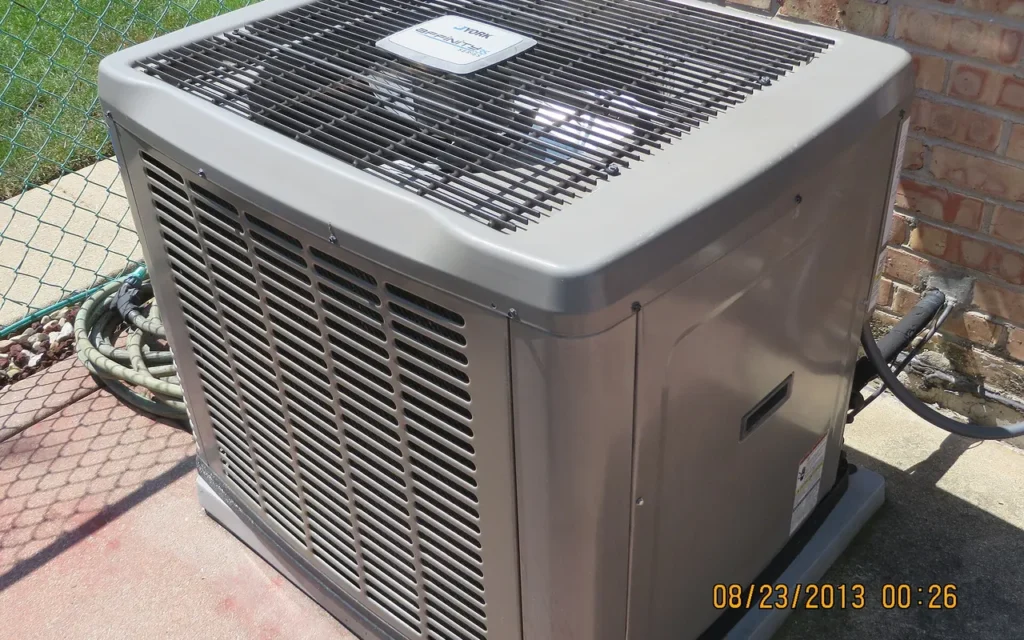
- Central air: a 3 ton unit can need about 3,500 watts running and a much bigger start-up surge.
- Electric water heater: commonly 4,500 watts while heating.
- Electric range or dryer: each can pull several thousand watts.
If those have to run, you’re in standby generator territory. See standby sizing for a 2,400 sq ft home. Otherwise, run big loads one at a time. To connect a portable to hardwired circuits like the furnace or well pump, you’ll need a transfer switch or interlock.
Gas heat or electric heat?
A home with gas heat and a gas water heater is easy to back up with a portable. The furnace blower and controls are a few hundred watts. An all-electric home is different: heat pump, resistance baseboards or an electric water heater can each need thousands of watts. That usually pushes you toward a large portable with load management, or a standby unit. See running a heat pump on a portable.
Bigger generator, bigger fuel bill
Bigger generators burn more fuel, even at light load. As a rough guide from manufacturer spec sheets, a 7,500 watt gasoline portable may use around 0.5 to 0.6 gallon per hour at quarter load and more than a gallon per hour near full load. Use the fuel run-time calculator to see what your setup will cost to run for a day.
Sizing errors to avoid
- Sizing from the box’s “starting watts” number. Size from running watts, then check the surge.
- Forgetting 240 volt needs. A well pump needs a 240 volt outlet and a transfer switch.
- Buying the biggest model “to be safe”. You pay for it in fuel, noise and weight every hour it runs.
- Ignoring altitude and heat. Engine output falls at high elevation. Many manuals give a derating figure.
When a standby makes more sense
If you lose power often, need air conditioning for health reasons, or can’t safely refuel and move a 200-pound generator, a standby system may be worth the cost. Compare in portable or standby generator.
With your list in hand, the answer is usually clear. If the essentials fit a 7,500 to 10,000 watt portable with some load juggling, that’s the affordable route. If they don’t, a standby, or a shorter list, is the honest alternative.
Whole-house portable FAQ
Will a 10,000 watt portable run my whole house?
It can cover a lot, often including a small central AC, but rarely an electric range, water heater and AC at the same time.
Can two portables power a whole house?
Not safely tied together into one panel without manufacturer-approved equipment. One properly sized generator is better.
What about load-shedding devices for portables?
Some transfer switches include load management. They let a portable cover a big load like an AC by shedding other loads.
Try your own list in the wattage calculator.
