

As an Amazon Associate, I earn from qualifying purchases. Some links in my guides go to Amazon, and buying through them costs you nothing extra. Read the disclaimer.
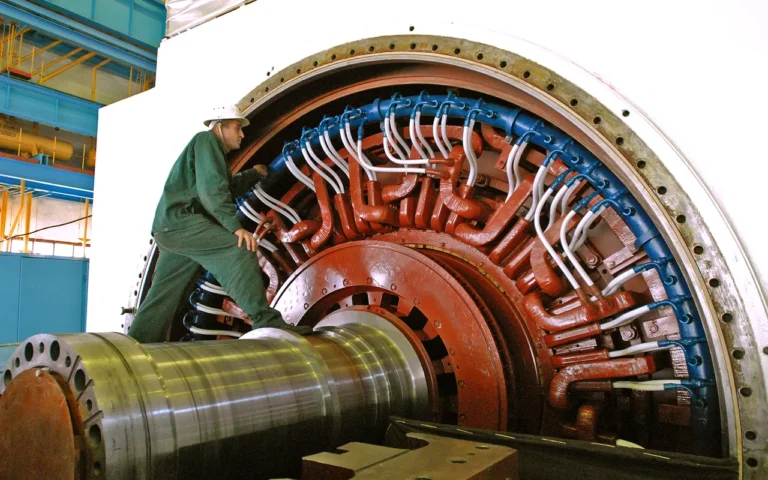
A portable generator is a small engine connected to an alternator. The engine spins a magnetized rotor inside coils of copper wire called the stator. The moving magnetic field induces an alternating current in those coils. That’s the same principle, scaled down, used in power stations like the one in this article’s photo. Electronics then regulate the voltage, and the power comes out at the outlets.
Inside the frame: the main parts
- Engine. Usually a single-cylinder, four-stroke gasoline engine. Many models also run on propane (dual fuel).
- Alternator. The rotor and stator. On conventional generators the rotor spins at a fixed speed to make 60 Hz power.
- Voltage regulation. An automatic voltage regulator (AVR), or the inverter electronics on inverter models, keeps output near 120/240 volts as the load changes.
- Fuel system. Tank, fuel valve, carburetor or regulator for propane, and a fuel shutoff.
- Control panel. Outlets, circuit breakers, a start switch, often an hour meter, and sometimes a CO shutoff sensor.
- Frame or enclosure. An open tube frame on many conventional models, a quiet enclosure on most inverters.
From spinning engine to 60 Hz
A two-pole alternator produces one AC cycle per revolution. To get 60 cycles a second (60 Hz), it has to spin 60 times a second, which is 3,600 revolutions per minute. That’s why conventional portables run at a constant, loud 3,600 rpm. In 50 Hz countries, conventional generators run at 3,000 rpm. Inverter generators break that link, which is why they can idle down.
Conventional vs inverter designs
Conventional: a two-pole alternator must spin at 3,600 rpm to produce 60 Hz. The engine runs at that speed whatever the load, which is loud and less fuel-efficient at light loads.
Inverter: a multi-pole alternator makes high-frequency AC, which is converted to DC, then electronically back into clean 60 Hz AC. Because frequency no longer depends on engine speed, the engine can slow down at light loads. That’s why inverter models are quieter and more efficient at partial load. More detail is in does an inverter generator produce AC or DC.
What running and starting watts mean
The running (rated) watts are what the generator supplies continuously. The starting (surge or maximum) watts are a short burst for motor start-ups. Size from running watts and check the surge. See what size portable generator you need.
Safety features worth having
- CO shutoff. Many newer models shut down if carbon monoxide builds up, following voluntary safety standards (ANSI/PGMA G300 and UL 2201). It’s a backup, not permission to run indoors.
- Low-oil shutdown, which protects the engine.
- GFCI outlets on 120 volt receptacles.
- Circuit breakers on each outlet group.
Using one safely
- Outdoors only, at least 20 feet from the house, exhaust pointed away (CPSC).
- Connect through extension cords or a properly installed transfer switch, never a wall outlet.
- Refuel only when the engine is off and cool.
- Keep a battery CO alarm in the house.
Maintenance in brief
Change the oil on the manufacturer’s schedule, keep fuel fresh or stabilized, clean or replace the air filter, check the spark plug, and run the generator periodically. See which oil to use and how to store a portable generator.
Put simply, every portable generator does the same three things: it burns fuel to spin an engine, turns that motion into electricity in the alternator, and delivers it through outlets and breakers sized for its rating. The differences between models come down to how well each step is done.
Generator basics: reader questions
Why does my generator speed up when I plug something in?
On inverter models, the engine speeds up to meet demand. On conventional models, the governor holds speed and you’ll hear the engine work harder.
Do generators make DC?
Some have a 12 volt DC outlet for battery charging. The main output is AC.
What is an AVR?
An automatic voltage regulator adjusts the alternator’s magnetic field to hold the output voltage steady as loads change.
What does “brushless” mean?
Some alternators use no brushes to carry current to the rotor, which reduces maintenance. Many small generators are brushless.
What makes a generator “dual fuel”?
A fuel system that can feed either gasoline through the carburetor or propane through a regulator and mixer.
Why do generators have both 120 and 240 volt outlets?
The alternator has two windings. Used separately they give 120 volts, and combined they give 240 for larger appliances.
See the portable and inverter hub for more.
