

As an Amazon Associate, I earn from qualifying purchases. Some links in my guides go to Amazon, and buying through them costs you nothing extra. Read the disclaimer.
Often, but not always. Many home standby packages from brands like Generac, Kohler and Briggs & Stratton are sold with an automatic transfer switch (ATS) included. Others are sold as the generator only, so the installer can choose a switch to suit your panel. Always check the model number and the quote.
How an automatic transfer switch works
- The ATS senses the utility voltage drop.
- After a short delay, to ignore brief blips, it signals the generator to start.
- Once the generator is at speed and voltage, the switch transfers your load to it.
- When utility power returns and stays stable, it transfers back and the generator runs a cool-down before shutting off.
Delays are adjustable on many controllers. Your installer sets them.
Types of transfer switch
| Type | What it does | Good for |
|---|---|---|
| Whole-house, service-rated ATS | Sits between the meter and your panel and moves the entire service to the generator. Often doubles as the main disconnect. | Whole-house backup, especially with load management |
| Essential-circuit ATS with subpanel | Moves a chosen group of circuits to the generator | Smaller generators, tighter budgets |
| Smart switch with load management | Sheds and restores big loads automatically so the generator isn’t overloaded | Covering AC or other big loads with a smaller generator |
Why the switch choice matters
- Code. Newer NEC editions require an outdoor emergency disconnect for homes (NEC 230.85). A service-rated ATS outdoors can satisfy that in some setups.
- Load management. Without it, a whole-house switch on a modest generator can overload when everything starts at once.
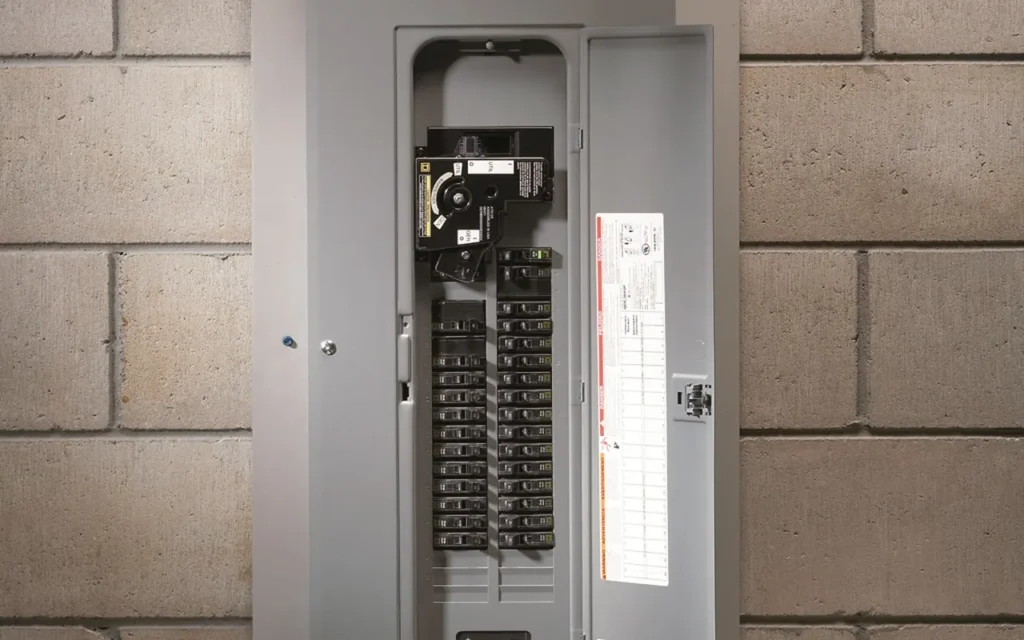
- Panel compatibility. Older or crowded panels may need work before a switch can be connected.
Is a switch in the box?
- Read the product listing. Generac, for example, sells several Guardian models “with whole-house switch” and some as generator-only.
- Check the switch rating in amps (100 A, 150 A, 200 A) and whether it’s service-rated.
- Ask the installer to list the switch model on the quote.
Questions to ask before you sign
- Exactly which transfer switch model is included, and what’s its amp rating?
- Is it service-rated, and will it act as the outdoor service disconnect?
- Whole-house or essential circuits?
- Is load management included, and which loads will it shed?
- Who handles the utility notification and permits?
- What warranty covers the switch, and is installation by an authorized dealer required?
Two buying errors leave people without a working switch:
- Buying a generator-only model online without arranging the right switch.
- Mixing brands without checking compatibility. Some controllers communicate only with matching switches.
- Choosing an essential-circuit switch, then expecting whole-house coverage.
Transfer switch selection and installation is licensed electrical work, and manufacturers usually require proper installation for warranty coverage.
Testing it after install
A good installer simulates an outage before leaving, usually by switching off the utility supply to the switch. You should see the generator start, the switch transfer the load after its time delay, and then a retransfer when utility power returns, followed by a cool-down run. Ask to be shown how to do this yourself, and where the switch and generator controls are.
Ongoing checks
- Watch or listen for the scheduled exercise run. Many controllers report it in an app.
- Keep the area around the switch and generator clear.
- Have the switch inspected as part of the generator’s annual service, including tightness of connections and contactor condition.
If a quote names the generator but not the switch, make that your first question. The switch decides how much of the house is covered and how the install meets code, so it deserves as much attention as the generator itself.
ATS questions
Can I add an ATS to a portable generator?
Automatic switching needs a generator with automatic start, which few portables have. Portables normally use a manual switch or interlock. See transfer switches for portables.
Does an ATS work without the generator running?
It stays on the utility side. It transfers only when the generator is ready.
Can I manually force a transfer?
Many controllers have a test mode. Use it as the manual describes.
Can I reuse an old transfer switch?
Only if it’s compatible with the new generator’s controller and rated correctly. Your installer will check.
Does the switch need maintenance?
Have it inspected during annual generator service. Technicians check connections, contactors and controller function.
Continue with how a standby is wired, safety disconnect rules and installation costs.
