

As an Amazon Associate, I earn from qualifying purchases. Some links in my guides go to Amazon, and buying through them costs you nothing extra. Read the disclaimer.
A standby generator connects to your home through an automatic transfer switch (ATS). Heavy power conductors run from the generator to the switch. Low-voltage control wires let the two talk to each other. The switch connects either to your whole service, between the meter and panel, or to a subpanel of essential circuits. A separate gas line feeds the engine.
The four main connections
- Generator to ATS (power). Conductors sized for the generator’s output breaker, run in conduit or a listed cable, plus an equipment grounding conductor. Generac’s 22 kW Guardian, for example, has a 100 amp main line breaker.
- Generator to ATS (control). Low-voltage wires carry the start signal, utility sensing and, on smart systems, load-management data. Manufacturers specify the wire type and separation from power conductors.
- Utility to ATS. On a service-rated whole-house switch, the meter feeds the ATS, which then feeds the main panel.
- ATS to panel. Feeds the main panel, or an essential-loads subpanel.
- Grounding and bonding. The neutral-to-ground bond stays at the service equipment. Whether the generator’s neutral is bonded depends on whether the switch moves the neutral. Your installer follows the manufacturer’s instructions and the NEC.
- Gas. A dedicated line with a shutoff valve and sediment trap, sized for full-load flow, ending in a flexible connector at the generator.
Service-rated or not: where the switch sits
A service-rated switch has its own main breaker and sits ahead of your panel. It can serve as the service disconnect, which helps meet outdoor disconnect rules in newer codes. A non-service-rated switch goes after an existing main breaker, often feeding a subpanel.
How load management is wired
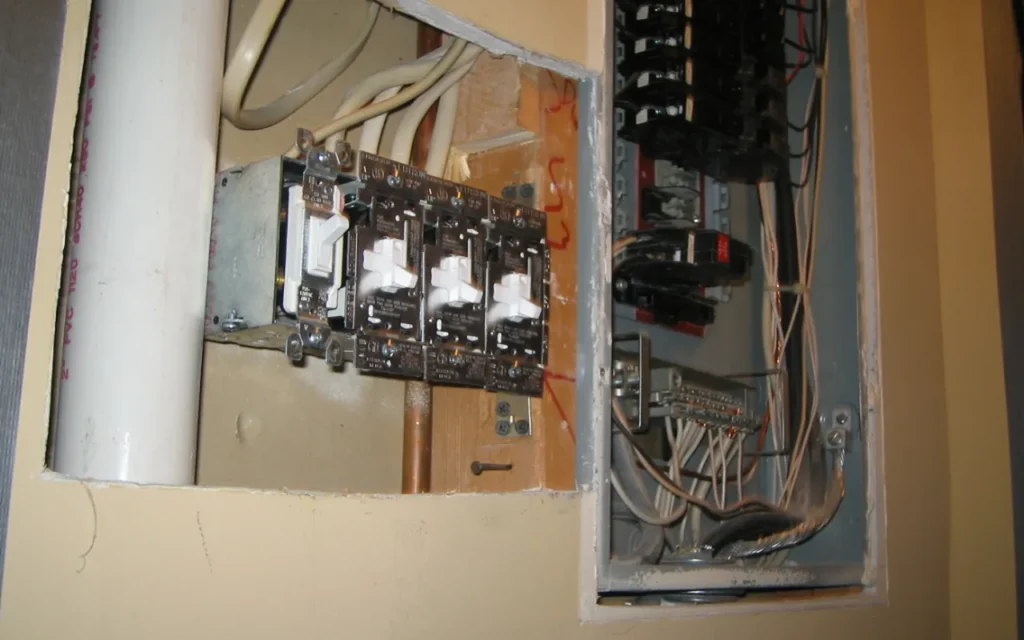
Smart switches can shed big loads. They might interrupt the AC’s thermostat signal, or use relay modules on 240 volt circuits like a water heater. That keeps a modest generator from overloading during startup surges.
Placement rules that shape the wiring
- Manufacturers specify clearances from windows, doors, vents and walls. Generac’s installation guides list these, and local codes can be stricter.
- The emergency shutdown and disconnect must be reachable outside in jurisdictions on the 2020 NEC or later. See safety disconnect requirements.
- Shorter runs to the meter and panel reduce cost and voltage drop.
Install day, in order
- Morning: the pad is set and the generator placed. The transfer switch is mounted near the meter or panel.
- Midday: conduit runs between the generator and the switch, power and control conductors are pulled, and the switch is connected to the service or subpanel. The utility may need to pull the meter briefly for service-side work.
- Afternoon: the gas line is completed and pressure-tested, the generator is started, settings are configured, and a simulated outage is tested.
- Later: electrical and gas inspections, sometimes on separate days.
Commissioning checks
- Phase rotation and voltage at the switch on both sources.
- Gas pressure at the inlet under load.
- A simulated outage to confirm automatic start, transfer and retransfer.
- Exercise schedule set in the controller.
Labels you should see
- At the service: a label identifying the generator as an alternate power source and the location of its disconnect.
- At the generator: shutdown instructions and the breaker.
- At the transfer switch: ratings and source identification.
Labels help firefighters, utility workers and future electricians. Inspectors often check them.
Common wiring faults
- Running control wires in the same conduit as power conductors when the manufacturer forbids it.
- Leaving a second neutral-ground bond in the system.
- Undersized gas piping.
This is licensed electrical and gas work in essentially all jurisdictions, with permits and inspection. Use this guide to understand the quote, not to do the install.
If you’re reviewing a quote, check it in this order: where the switch sits, how the power and control wiring run, whether load management is included, and whether commissioning and labeling are listed as part of the job.
Distance, panels and the battery
Can the generator be far from the panel? Yes, but longer runs need larger conductors to limit voltage drop, and that costs more.
Do I need a new panel? Not usually, but older or overloaded panels sometimes need upgrades before a transfer switch can be connected.
Where does the battery go? Inside the generator enclosure. It’s kept charged by the generator’s built-in charger.
Related reading: does a standby include a transfer switch, sizing a standby and the standby hub.
